
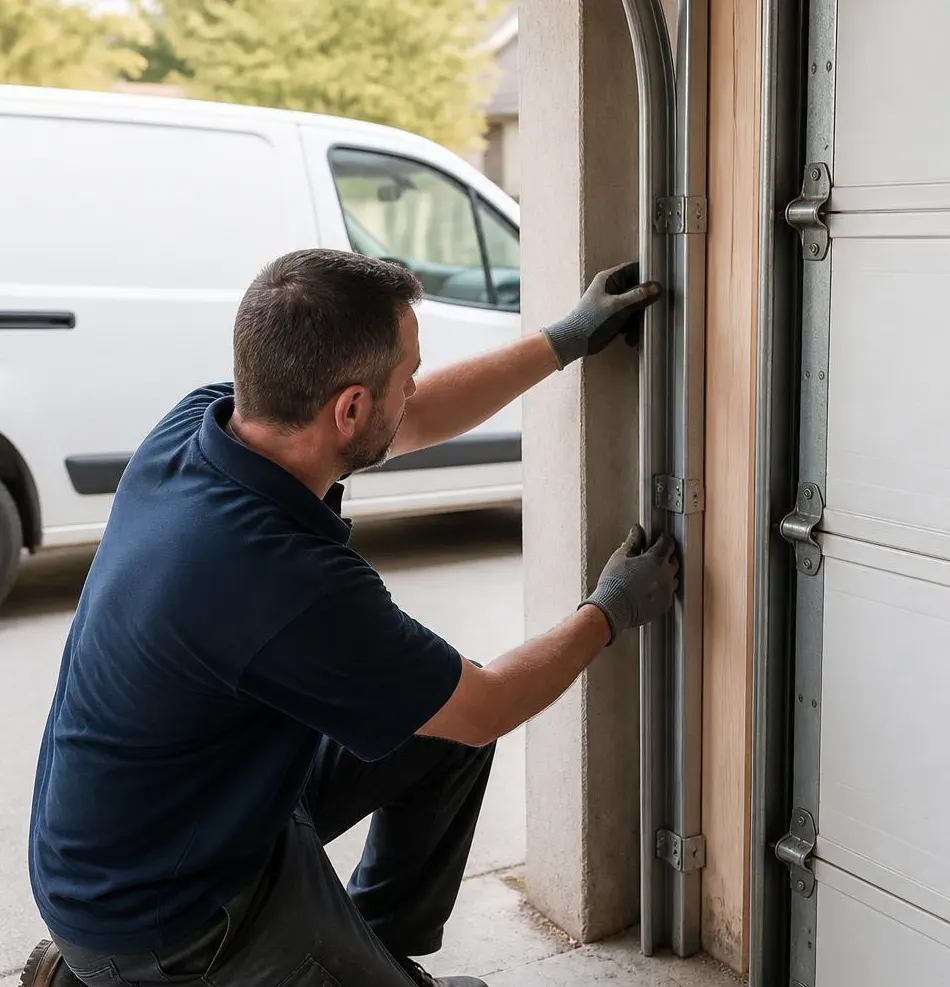
The one-sentence rule
A properly balanced garage door will stay put wherever you let go of it, anywhere along its track, and move up and down with just a few pounds of hand pressure. If it drifts shut, slams down, or suddenly feels heavy at one spot, the springs aren't carrying their share of the weight anymore.
There are a few exceptions worth knowing before you panic. A door will naturally feel slightly different in the last few inches at the very top and very bottom — that's normal spring behavior, not imbalance. Brand-new installations sometimes need a short settling period. And a door can test "balanced" by hand while still having worn rollers or a bent track causing noise or binding — balance and smooth travel are related but not identical problems.
Tools you'll need
- A step ladder
- Work gloves
- A flashlight
- A second person to help, though not strictly required
Step-by-step: testing balance
- Close the door fully. Start from the closed position so you have a full range to test.
- Disconnect the opener. Pull the red release cord hanging from the trolley so the door is running on spring power alone, not the motor.
- Lift the door by hand about halfway. Use slow, steady effort, not a yank.
- Let go and watch it. A balanced door stays roughly where you left it. It may drift an inch or two, but it shouldn't fall or shoot upward.
- Repeat at the three-quarter-open position. Same test, same result expected.
- Lower the door back down by hand and pay attention to whether one side drops faster than the other, or whether you hear grinding, popping, or scraping along the way.
- Look, but don't touch, the springs. With the door closed, shine a flashlight on the torsion spring above the door or the extension springs along the upper track. Visible gaps between coils, one spring looking noticeably stretched compared to the other, or rust streaking down from the coils are all signs of a spring problem developing.
- Reconnect the opener and run the door through a normal open-close cycle, listening for the motor straining, clicking under load, or moving slower than usual partway through the cycle.
What a homeowner should and shouldn't do
Everything above — lifting the door by hand, watching where it holds, listening to the opener — is safe for a homeowner to check. What's not safe to DIY is anything involving the springs themselves. Torsion and extension springs are under enough tension to cause serious injury if adjusted or released incorrectly, and that work should always go to a trained technician.
What an unbalanced door does to your opener
Garage door openers are built to move a balanced door, not to lift one. When springs weaken, the motor has to make up the difference every single time the door runs. That extra load shows up as a straining sound partway up the cycle, a door that reverses unexpectedly because the opener thinks it's hit an obstruction, or a chain or belt that stretches and slips faster than it should. Over months, that extra strain burns out gears, wears down the drive mechanism, and shortens the life of a motor that should otherwise last well over a decade. In this area, doors also get cycled more during the rainy season — people closing up quickly ahead of afternoon downpours — so an unbalanced door gets worked harder exactly when it's least able to handle it. Salt-tinged air near the coastal parts of our service area can also accelerate spring corrosion, which speeds up the whole problem.
When to call Rotonda West Garage Door Service
If your door drifts, drops, or your opener sounds like it's working too hard, it's time to call rather than keep testing. We handle Garage Door Spring Repair to restore correct tension safely, and if the opener itself has already taken damage from months of overwork, we also handle Garage Door Opener Installation for a full replacement. Either way, we'll rebalance the door properly and check that it meets the wind-load hardware your home needs for storm season.
If you're anywhere in Rotonda West, Englewood, Port Charlotte, Punta Gorda, North Port, Cape Haze, Placida, or Grove City and your garage door isn't holding steady, give Rotonda West Garage Door Service a call — we'll come out, test it properly, and fix whatever's actually wrong.